How the New Norm is Reshaping the Context for Planning Downtown
Updated: 6 hours ago
David Dixon FAIA explores how converging economic, demographic, and social forces make walkable, inclusive, mixed-use neighborhoods essential to downtown’s future.
By David Dixon FAIA
Adapted from In Walking Distance: How Five-minute Neighborhoods Are Reinventing Downtown (Princeton University Press, May 2027)
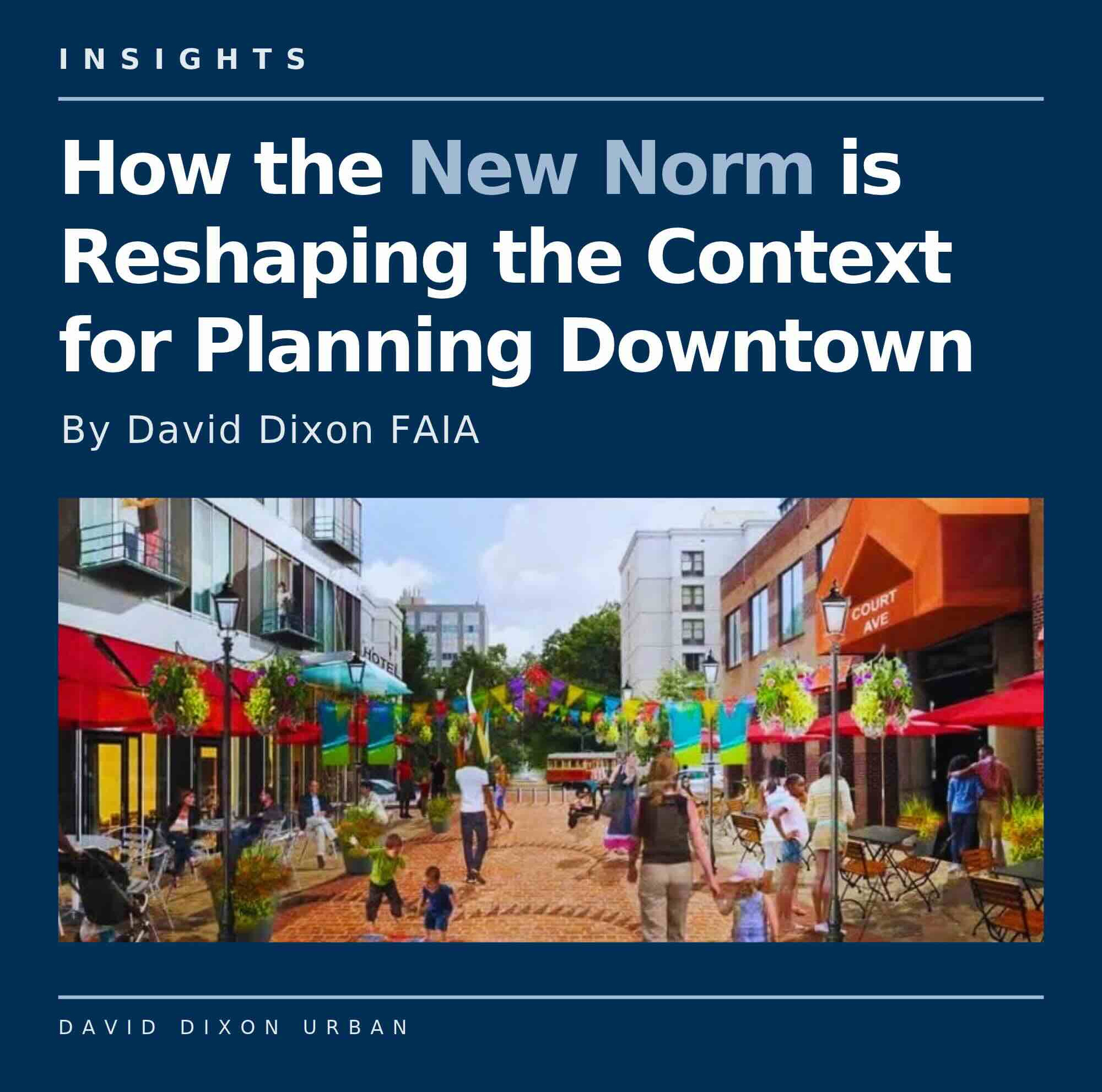
Even before the pandemic, a powerful convergence of economic, demographic, mobility, equity, fiscal, and environmental forces was reshaping cities, suburbs, and whole regions. Today, these dynamics have crystallized into what I call the New Norm—a transformative alignment of forces that defines the context in which downtowns—and their cities, suburbs, and regions—must plan for the future.
Emerging from the pandemic, reinvention must accompany recovery if downtowns are to thrive in the emerging idea economy era.
The New Norm rejects the outdated notion of downtown as a single use office district. Christopher Leinberger’s insight that downtown functions as a dynamic “organism” captures the essential shift: residential, retail, cultural, recreational, and civic uses must interact and nourish one another to create resilient, vibrant districts. This integrated live work play and innovate model is now the foundation for competitive downtowns. A holistic approach—one that nurtures livability, economic opportunity, equity, sustainability, and mobility simultaneously—is essential. Even more essential? Grounding this approach is a full understanding of the New Norm.
Let’s take a look.
Economic Transition: The Idea Economy’s Race for Talent
A central driver of the New Norm is the accelerating shortage of educated workers. Without immigration, the US workforce would have started to shrink in 2017, And even with current immigration levels, workforce growth in 2040 will be half of what it was in 2010. Every developed economy faces this challenge. And as Japan’s plight illustrates, no developed economy can grow without growing its workforce.
The idea economy, which is quickly replacing the service economy as the dominant driver of US economic growth, intensifies this challenge. Georgetown University’s Center on Education and the Workforce reports that between 1983 and 2021, two thirds of net new U.S. jobs required a bachelor’s degree or higher—and projects that all net new jobs between 2021 and 2031 will require at least a bachelor’s degree. By 2030, educated workforce—“talent”—shortages could leave more than five million idea economy jobs unfilled, costing the U.S. economy over $5 trillion annually.
This scarcity has reversed a long standing dynamic: jobs now follow talent, not the other way around. Downtowns—dense, walkable, amenity rich environments—have emerged as the primary magnets for this mobile, lifestyle driven workforce for their cities and regions. Already, cities with vibrant downtowns often report median household incomes 50 percent higher—and in some cases double—those of cities at the other end of this spectrum.
Density is Destiny. Downtown density represents an essential economic asset. Dense, walkable, mixed-use environments attract and retain talent and generate “creative collisions”—the spontaneous interactions that spark new ideas and fuel innovation. The core building block? Housing at sufficient scale to support nearby cafés, microbreweries, shops, entertainment venues, and other amenities that appeal to talent and foster collisions.

AI and the Future of Talent
Contrary to popular fears, AI is poised to increase—not decrease—regional competition for talent. As research professor at George Washington University and former lead analyst of occupational trends at the Bureau of Labor Statistics, Michael Handel, notes: AI will automate routine tasks but expand demand for highly educated workers. The World Economic Forum projects a net increase of 7 percent in global employment by 2030 due to AI. Ezra Klein’s observation that “the spreadsheet didn’t replace the accountant” but instead unleashed latent demand for financial intelligence underscores this dynamic.
For the foreseeable future downtown’s economic development imperative will be, in Jane Jacobs’s words, “to be a place for people”—a live/work/play/learn environment whose five-minute neighborhoods offer a rich sense of community and nurture interaction.
Demographic Shifts: The Rise of Child Free Households
Demographic change is equally transformative. Between 2025 and 2045, 70–80 percent of net new U.S. households will not include children, and by 2040 fewer than one in four households will have a child under eighteen. These households prioritize walkability, proximity to restaurants, parks, and opportunities for social interaction—think downtown.
Demand for downtown housing already exceeds supply and downtown will face unprecedented housing demand for the next two decades and beyond. Smart Growth America reports that walkable urban housing commands a 30–40 percent premium per square foot, and demand already exceeds supply by roughly four to one. Even households with children increasingly want to live downtown—provided schools, childcare, parks, and sufficiently large and affordable housing are available.
Housing has emerged as downtown’s principal building block.
Fiscal Pressures: The New Budget Reality
Cities face mounting fiscal pressures that reinforce the importance of renewed downtown strength, Aging populations will drive up healthcare, mobility, and social service costs. Pension and benefit obligations are projected to rise from under 15 percent of city budgets today to more than 20 percent by 2040. Climate related infrastructure costs will escalate. And the decline in downtown office values—formerly responsible for 15–40 percent of citywide property tax revenues—has created significant budget gaps: Pew reports that at least twenty of the twenty five largest U.S. cities face fiscal shortfalls for 2026 and beyond. Downtown housing that takes advantage of downtown density will be essential to fill this gap.
Mobility Innovations: A New Urban Advantage
Mobility is undergoing its most significant transformation since the arrival of universal access to cars after World War II. Micromobility, shared mobility, connected and autonomous vehicles, and autonomous transit can significantly enhance downtown’s quality of life—if cities plan proactively.
By 2040, connected mobility will likely be the norm, enabling vehicles to “see” pedestrians, avoid hazards, and coordinate movement. Soon after, autonomous “mobility as a service” could reduce downtown household transportation costs by 50 percent—equivalent to a $5,000–$7,500 annual subsidy for downtown living.
These innovations could reduce parking needs by 70–90 percent, freeing land for housing, parks, and retail while lowering development costs. Autonomous shuttles can strengthen first last mile connections and integrate seamlessly with transit.
With the right planning, mobility innovations that enhance downtown connectivity could help reverse sprawl and reinforce downtown’s competitive advantage.
Environmental Responsibility: The Kaid Benfield Conundrum
High density, walkable downtowns offer profound regional environmental benefits. Auto dependent suburbs generate two to four times the per capita emissions of walkable urban neighborhoods. Concentrating growth preserves natural habitats, reduces energy consumption, and supports renewable energy adoption. Yet as Smart Growth America co-founder Kain Benfield notes, dense downtowns can also produce significant environmental hazards—particularly poor air quality—without the right planning and public policies.
Health Awareness: Walkability Really Matters
Public health impacts are even more striking. Larry Frank reports that increased walking and biking in downtown reduces the incidence of diabetes, heart disease, high blood pressure, and depression by more than 50 percent. Moving individuals from the lowest to the highest quartile of walking time increases average lifespan by roughly a decade. Poorer health associated with auto dependency adds $1,000–$4,000 per person annually to U.S. healthcare costs—totaling about $1 trillion each year.
Equity and Inclusion: Downtown as an Engine of Opportunity
Income inequality has reached its highest level since the 1920s. As walkable downtowns have grown more expensive, poverty has shifted to suburbs, increasing economic segregation. Affordable housing challenges are acute: in 2024, nearly half of all renter households were cost burdened. In Boston, the gap between median rents and voucher holder incomes exceeds $70,000.
Yet downtowns remain powerful engines of inclusive growth. They represent the best opportunities to build mixed-income housing. With the right workforce readiness, skills training, and entrepreneurial support programs, each idea economy job can generate five additional jobs across the skill spectrum. As Kurt Weigle warns, “when downtown becomes identified as an island of white privilege, we’ve lost our chance to be the heart of our city.” Downtown must offer shared opportunity to earn broad political support.
The New Norm’s message? Plan now for a new era of unprecedented downtown imperative and opportunity.


